Collective intelligence
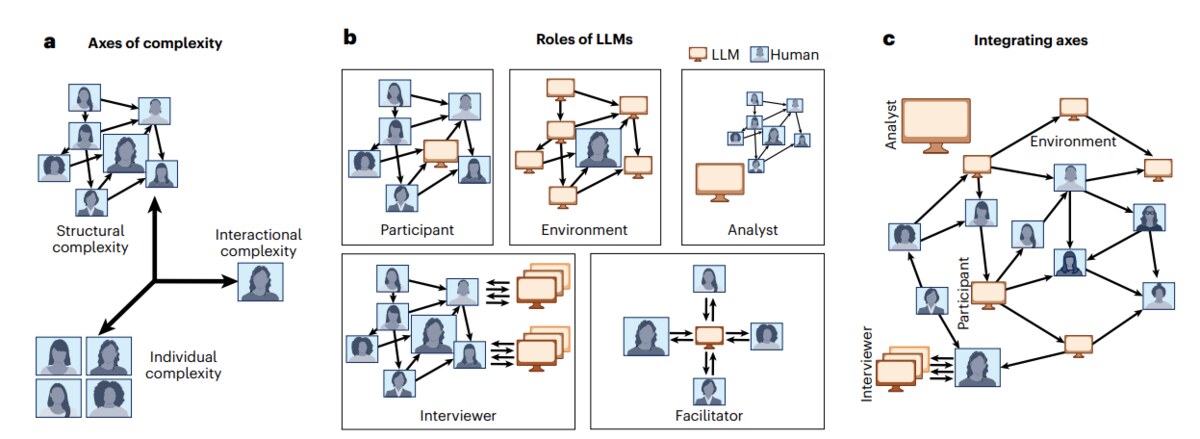
The lab’s fastest-growing program. We study coordination, cultural dynamics, and failure at scale, going beyond dyadic human-AI interaction to ask what emerges when many humans and many AIs share the same environment.
Representative work. Revisiting Rogers’ Paradox in the context of human-AI interaction (Phil. Trans. R. Soc. A 2026) ports a classical cultural-evolution result to the AI era. Language Model Teams as Distributed Systems reframes multi-agent LLM workflows using primitives from distributed systems. Using LLMs to advance the cognitive science of collectives (Nature Computational Science 2025) outlines the methodological agenda. Human-AI Synergy Supports Collective Creative Search and Why Human Guidance Matters in Collaborative Vibe Coding (2026) measure when humans and AIs are actually better together.