Research

Six active programs spanning the lab's three lines of inquiry: measuring shared structure between human and AI minds, designing interactive systems that leverage it, and diagnosing partnership failures. Click any card to read more.

01

Alignment between human and AI minds

How human and AI minds come to share structure, and how to measure, teach, and improve that alignment.

Read moreShow less
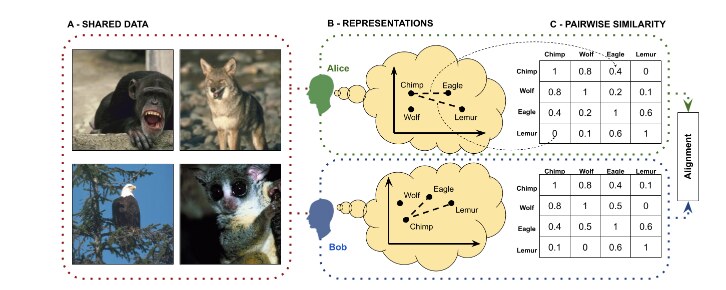
Schematic of two agents (Alice and Bob) seeing the same set of images, forming internal representations, and computing pairwise similarities; the question is whether their representations align.
Two minds looking at the same world. We measure when human and AI representations align, and what that alignment buys us.

The lab’s theoretical anchor. We study how minds, biological and artificial, come to share structure across representations, concepts, values, and perception, and we use that structure as a tool to make AI systems more compatible with people.

Representative work. Alignment with human representations supports robust few-shot learning (NeurIPS 2023 Spotlight) shows a U-shaped relationship between human-model representational alignment and downstream task performance. Getting aligned on representational alignment (TMLR 2025) lays out a community-wide research agenda for the field. On the informativeness of supervision signals (UAI 2023 Spotlight) develops the information-theoretic backbone connecting soft-label supervision to alignment.
02

Data-efficient learning (LO-shot)

How few examples does it take to learn, for machines and for people?

Read moreShow less
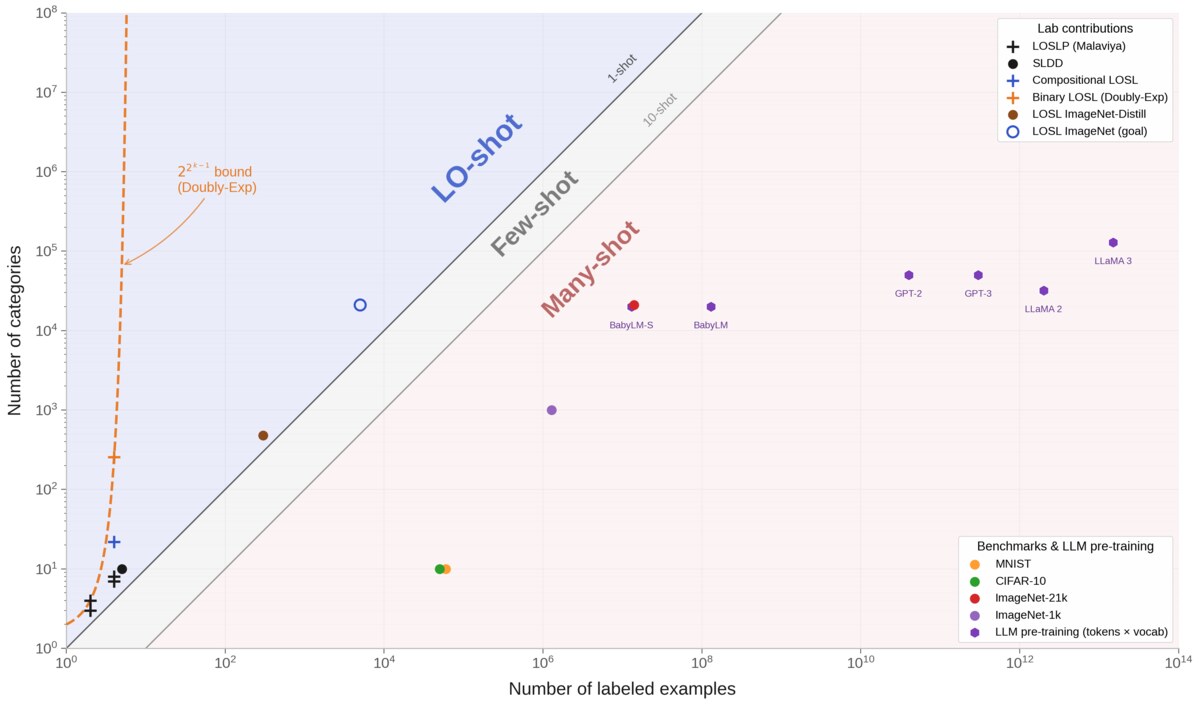
Two-axis log-log plot of number of categories versus number of training examples; LO-shot, few-shot, and many-shot regimes shaded; lab contributions plotted in the upper-left wedge; MNIST, CIFAR, ImageNet, BabyLM, GPT-2/3, LLaMA 2/3 plotted for scale.
The few-shot landscape. We work in the upper-left wedge, where a learner extracts more categories from a dataset than there are examples in it.

A multi-year program on the fundamental limits of learning from very few examples. We introduced less-than-one-shot (LO-shot) learning, the regime where a learner extracts more categories from a training set than there are examples in it. The program maps the theory, the human counterpart, and the implications for AI training.

Representative work. ‘Less Than One’-Shot Learning (AAAI 2021) launched the program. Soft-label dataset distillation (IJCNN 2021 Oral) develops the training-time mechanism. Using compositionality to learn many categories from few examples (CogSci 2024) extends to compositional concept structure. Learning a doubly-exponential number of concepts from few examples (CogSci 2025) pushes the theoretical ceiling further.

03

Cognitive science for AI diagnosis

Using classical psychology paradigms as measurement tools for AI representation and behavior.

Read moreShow less
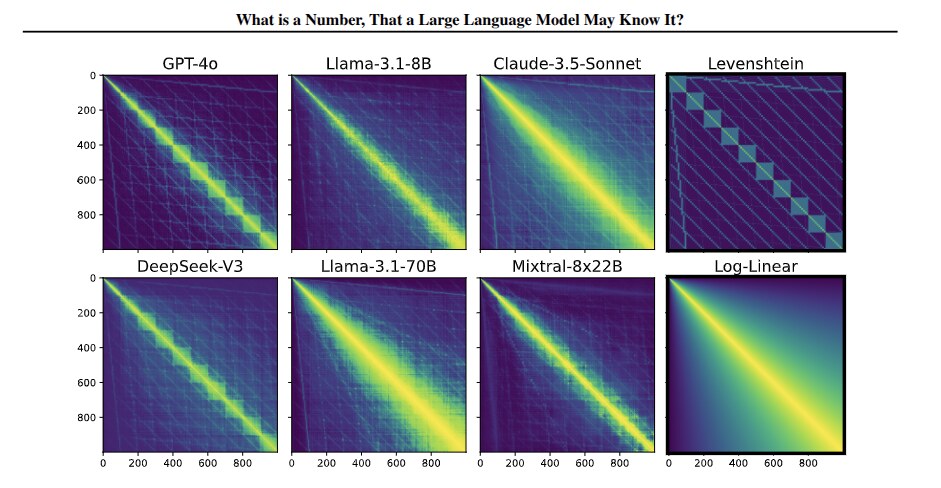
Eight similarity heatmaps showing how different language models internally represent the numbers 0 to 1000; modern LLMs show diagonal bands with log-scale structure resembling human numeric perception.
Probing what an LLM "knows" about numbers. The lab uses classical psychology paradigms as instruments to measure AI representation and behavior.

Cognitive science has spent a century developing paradigms that turn opaque minds into measurable behavior: implicit-association tests, serial reproduction, rational analysis, psychophysics, theory-of-mind probes, and Marr’s levels of analysis. We adapt those instruments and run them on AI systems, producing diagnostics that are interpretable, comparable to human baselines, and sensitive to subtle failures.

Representative work. Explicitly unbiased LLMs still form biased associations (Bai et al., PNAS 2025) imports the IAT into LLMs. LLMs surpass human experts in predicting neuroscience results (Luo et al., Nature Human Behaviour 2024) uses rational-analysis style benchmarking. Failing to falsify (2026) tests confirmation bias in language-model rule discovery. What is a Number, That a Large Language Model May Know It? (TMLR 2025) probes numeric representation.

04

Collective intelligence

What happens when humans and AIs interact in groups, as teams, networks, or populations.

Read moreShow less
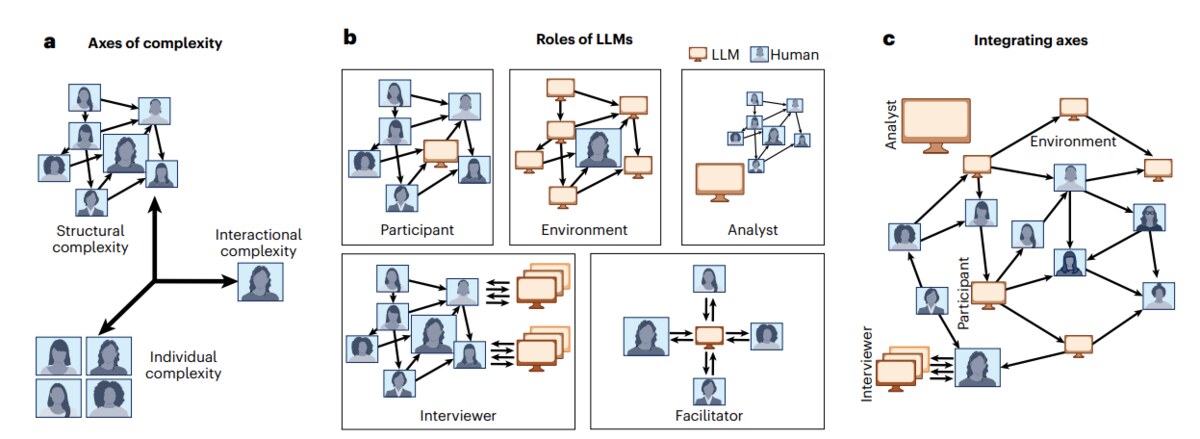
Three-panel schematic of mixed human-LLM groups: axes of complexity (structural, individual, interactional), the roles an LLM can play (participant, environment, analyst, interviewer, facilitator), and a combined network integrating those axes.
Mixed human-LLM groups along axes of complexity and the roles LLMs can play within them, from Using LLMs to advance the cognitive science of collectives (Nature Computational Science 2025).

The lab’s fastest-growing program. We study coordination, cultural dynamics, and failure at scale, going beyond dyadic human-AI interaction to ask what emerges when many humans and many AIs share the same environment.

Representative work. Revisiting Rogers’ Paradox in the context of human-AI interaction (Phil. Trans. R. Soc. A 2026) ports a classical cultural-evolution result to the AI era. Language Model Teams as Distributed Systems reframes multi-agent LLM workflows using primitives from distributed systems. Using LLMs to advance the cognitive science of collectives (Nature Computational Science 2025) outlines the methodological agenda. Human-AI Synergy Supports Collective Creative Search and Why Human Guidance Matters in Collaborative Vibe Coding (2026) measure when humans and AIs are actually better together.

05

Safe and trustworthy thought partners

How human-AI partnership breaks, and how to build AI that resists those failure modes.

Read moreShow less
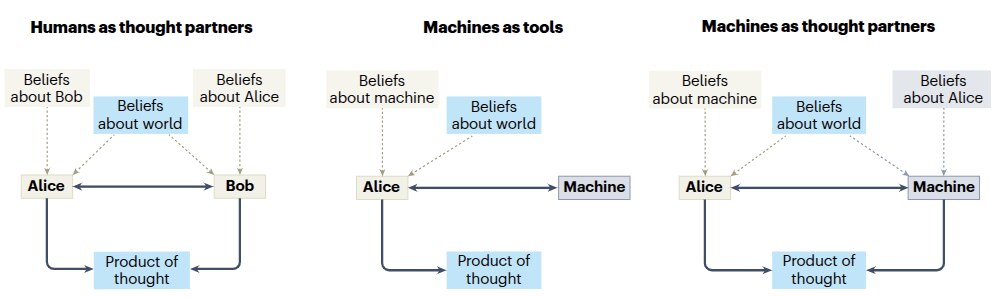
Three-panel triptych contrasting humans-as-thought-partners (Alice and Bob with beliefs about each other and about the world produce a shared product of thought), machines-as-tools (a machine in service of one human user), and machines-as-thought-partners (a machine reasoning about Alice and the world to co-produce thought).
From Building Machines That Learn and Think with People (Collins et al., Nature Human Behaviour 2024). Thought partnership requires beliefs about the other and a shared product, not just tool use.

Partnership has failure modes: bias, overreliance, manipulation, de-skilling, miscalibrated trust, and metacognitive blindness. We pursue three complementary directions: (1) diagnosing failures (measurement and taxonomy), (2) understanding how humans calibrate trust and decide when to defer to AI, and (3) engineering integrity through interventions and end-to-end systems.

Representative work. Identifying, Evaluating, and Mitigating Risks of AI Thought Partnerships (Oktar et al. 2025) frames the risk landscape. Measuring and Mitigating Overreliance (Ibrahim et al. 2025) makes the case for an integrated research program. Modulating Language Model Experiences through Frictions studies interventions for safer LLM use. Dimensions of Disagreement (Oktar et al., Decision 2025) maps when and how humans trust noisy advisors. Under the Influence: Quantifying Persuasion and Vigilance in LLMs (Robinson et al. 2026) characterizes how language models persuade and are persuaded.

Funding context. This program anchors the lab’s DARPA “In the Moment” (ITM) involvement (Algorithmic Trust at Scale, co-PI; 2025 to 2027).

06

Applied thought partnership

Where the AITP framework lands in the world: education, music, math, and robotics.

Read moreShow less
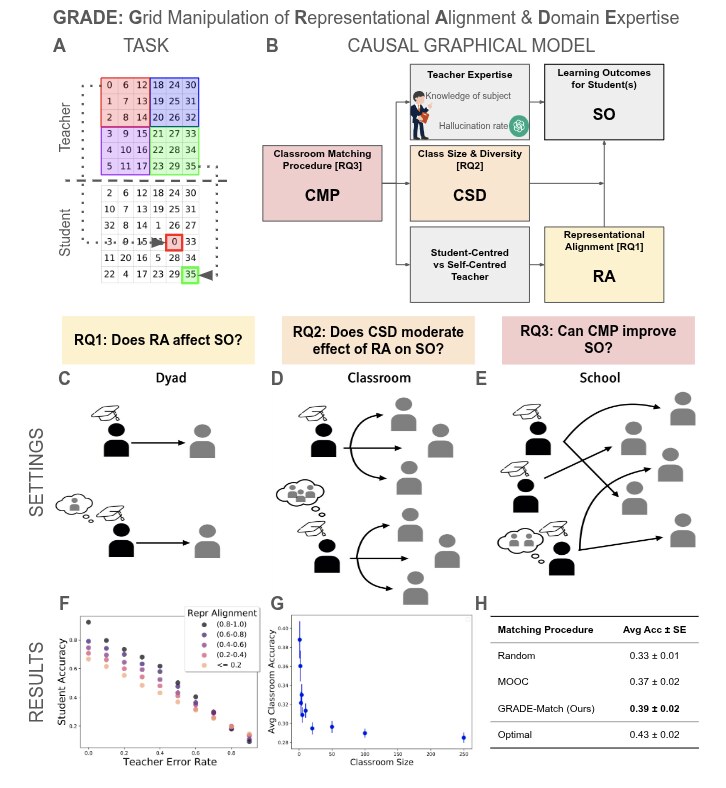
Schematic of representational-alignment-aware machine teaching: a teacher and a learner with internal representations, with the teacher selecting hints conditioned on the learner's representations so that the learner improves.
The GRADE system: machine teachers aligned to a learner's representations produce better hints. From Representational Alignment Supports Effective Teaching (Sucholutsky et al. 2025).

The applied face of the program. We translate AITP science into systems that work alongside people in specific domains, with each project chosen so the application also feeds back into the core science.

Education. Representational Alignment Supports Effective Teaching (Sucholutsky et al. 2025; the GRADE paper) shows that aligning machine teachers to learner representations improves hint quality. Adjacent work spans K-12 collaborations with the Children Helping Science network and graduate-level mathematics tutoring through the MATH-AI workshop community.

Music. Collaborative interactive editing tools for music, in development with collaborators across NYU, Cornell, and the music-cognition community.

Math. AI partners for graduate-level mathematical research.

Robotics. The LGA series on language-guided abstraction for robot learners, published at ICLR, HRI, and CoRL 2024.